 Default

-
The problem
Buying signals like hiring, funding and M&A were easy to get but sat in isolation. With no way to combine them at scale, reps fell back on manual research or gut feel, there was no single record that BDRs, AEs, marketing and the email-sending setup all worked from, and high-fit, in-market accounts were being missed.
-
What they built
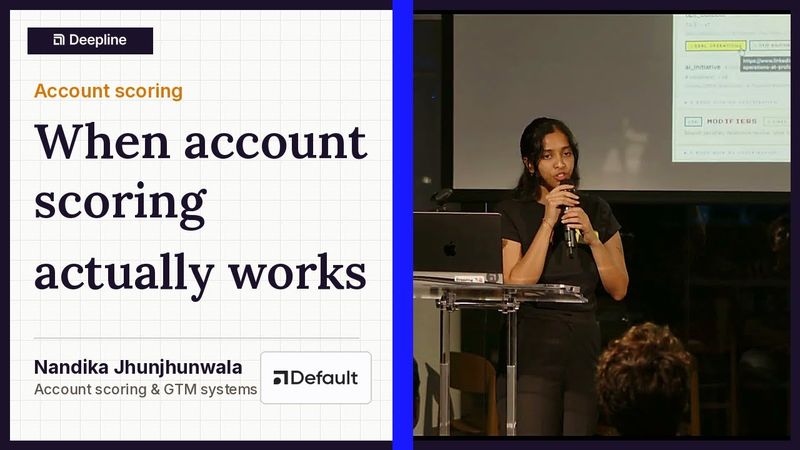
An account scoring system that pulls every signal Default cares about for a company, stores it in one place, and scores the account on two questions: is this the right kind of buyer (fit), and is it changing right now in ways that suggest it's ready to buy (timing). Accounts land in four tiers: P1 to call now, P2 for email and nurture, P3 for automated low-touch sequences, and P4 to ignore. A web app shows each account's data and lets the team score one-off accounts. Nandika built it with her manager acting as product manager; she says what was scoped as a 6 to 12 month project for a team of engineers took about a month with no engineers.
-
So what
Every rep knows which accounts to call this month and which get automated email. Because the system records the score at which meetings were booked, the scoring can be checked against results.
Under the hood
For GTM engineers
Accounts come in four ways: bulk CSV import, one-off scoring in the web app, Salesforce sync, and accounts that engage through website visits, form fills, email, LinkedIn or ads. They are enriched with Clearbit and other providers, stored in a 12-table Supabase Postgres database, and orchestrated with GitHub Actions. Fit covers firmographics and technographics (headcount, vertical, funding, growth stage, RevOps and GTM engineering presence, CRM setup); timing covers change signals. Job descriptions are stored and run through an LLM to infer signals such as AI initiatives or pains Default solves. Hard disqualifiers (e.g. B2C) apply. Scores write to a custom Salesforce field. Nandika chose a database over Clay because Clay suits one-time enrichment, not scoring a whole TAM, and a database gives audit logs and snapshots. Outcome data (score at meeting, touchpoints to convert) is stored to refine the model later.
More examples
Other systems GTM engineers have built, or see all of them.
-
 Ordo
School-lunch contract bids that took five people working late now run with two people, and more bids went out this year
 Hunter Rosenblume · CEO & Co-Founder
-
 LangChain
Cut the time it takes LangChain to reply to inbound leads by having an agent research each lead and draft emails that learn each rep's style
 Vishnu Suresh · Software Engineer
-
 Profound
AI agents check the company's Google Ads on a schedule and send suggested changes to Slack, where a person approves them
 Nick Lafferty · Founding Marketing Engineer
Hiring someone who can build like Nandika?
We search for GTM engineers who have shipped systems like this one, and Joe speaks to every candidate before you do.